Showing posts with label riding. Show all posts

Tuesday, May 8, 2012

Supportive parents

Helloo Fello Equestrians

Every kid has a dream they want.. whether it be small or big, or within school or in sports. It is hard when as a kid/young teen you have a sports goal in mind and you want to achieve it and your parents aren't exactly supportive about it. That has been my biggest challenge so far... Horseback riding is one of the most expensive and dangerous sports out there... its not like baseball or football or soccer where there is a small ball involved.. we work with 1000lb animals with a mind of there own. My parents agreed to enroll my sister and I in riding lessons about 9ish years ago.. it was all uphill from there, I was hooked from the moment I got on that school horse. My parents were ok with us riding in lessons because there was always supervision the problems came when my dad bought my sister and I a 6 month old appaloosa filly named DeeDee.  Horseback riding is a very expensive sport on a monthly basis it can cost anywhere from $350-$3000+ a month.

one of the first rides on my own horse, i was terrified!
All costs and dangers aside kids in todays day and age should be enrolled in either a school sport or a sport outside of school it keeps kids active and social. Having supportive parents in anything you do is helpful in away that keeps kids motivated to continue trying their best and achieving and setting more goals for them selves. My dad in particular was the one who bought the horse and has been there for me every step of the way. In the beginning he financially supportive my dream and now that im old enough to work I pay for everything. My dad and I would go out to the barn a few days a week and see my horse, because she was only 6 months old at the time there was a lot of training to be done with my horse. Of course we had our ups and our downs, but we spent countless hours working with my mare when she was young to get her the perfect horse for myself and my sister to ride now. I had only been riding for about 2+ years before my dad bought the horse... and knowing nothing about how to train a young horse or much about on the ground work, it all turned out ok. I remember to this day going out to the barn in the winter in -20 degree weather afraid of my horse because she was young and unpredictable but i knew i had to work with her because she needed a lot of ground work, respect and just general training to become the horse she is today. Back when my dad considered buying my horse, my mom immediately said no.. because of the costs and it was considered a "dangerous animal" she didnt want us around the horse at all except in lessons when we would have lots of supervision. In the end my dad made the right decision to buy us an exceptionally well bred appaloosa filly.

My dad and DeeDee in the early days 


Today: May 7th 2012

She is currently 7 years old and broke to ride English, has fantastic bloodlines and I'm planning on continuing her bloodlines by breeding her in a year or so. From all the training back when she was a yearling and up she was fairly easy to train, she had her moments but we got over those and she has been a dream to ride ever since.

these were the days when i was afraid of her..

There were days were i would get no where with her and just would think it was a waste of time and money, many days i cried and wanted to give up riding, training her.. everything to do with horses. Im glad i stuck it out. I now have the chance to grow as a rider,trainer and horse women in general all with the help of the new people at my barn. :)

DeeDee was almost 3 here

Today at 7 years old.


I thank both my parents for being supportive and sticking with my through thick and thin.. good times and the bad, we've pulled through some really rough times with the horse but made it.  I gladly thank them for that. :) 


Thursday, April 26, 2012

Entry Level Reining.. Have you tried it?


NRHA’s program for beginning reiners provides a fun, educational, and family-oriented ladder of competition.


The program: The National Reining Horse Association’s new “starter levels” of competition, which debuted in 2010, welcome riders of all backgrounds and abilities to the sport of reining. The Green Reiner class in particular takes the pressure off if you’re at the very beginning/introductory level of the sport, and wouldn’t feel comfortable in NRHA’s more competitive Rookie Reiner division. Green Reiners compete at one of two levels depending on prior points and monies earned, so that the more advanced Green Reiners aren’t mixed in with the newest of the newbies. Moreover, once a rider earns 100 Green Reiner points, he or she is no longer eligible to compete in that class, making it truly an entry-level competitive opportunity. NRHA’s complementary “Ride” and “Slide” classes offer small steps up to slightly tougher competition, creating an inviting ladder by which you can improve your performance in the sport.
Players: All types of riders. You need only an NRHA associate membership ($20) to compete in any of the entry-level classes, and you needn’t even own the horse you show. For both the Green Reiner and Ride classes, neither non-pro declarations nor competition licenses are required.
Other Advantages: Patterns are tweaked to make first experiences less intimidating. In Green Reiner classes, for example, you can ride with one or two hands, plus choose between simple (through-the-trot) or flying lead changes. Ride classes may also have reduced pattern requirements. You don’t need fancy gear or attire, either—just a long-sleeved shirt, a hat or helmet, boots, and a Western saddle and bridle.
Good to Try If: You’ve always admired reining but thought it was “above your pay grade.” In these classes, the atmosphere is supportive and encouraging, and you’ll always be competing against riders with about the same level of experience as you.
Success Tip: Work with a trainer or a knowledgeable friend to learn the basics, watch how the pros and experienced non-pros do it to absorb their knowledge and techniques, and ride a veteran reining horse if at all possible. “A seasoned horse allows you to learn how to rein versus trying to school a green horse while you’re learning yourself,” recommends Butch Human of Advance, North Carolina. Butch earned his Green Reiner buckle in less than six months aboard his “old war horse,” Mr Jerry Jac. “My wife and I started riding green horses and we struggled. With this gelding, I could go into the pen and think about what I needed to do, instead of worrying about my horse.”
The Buzz: These entry-level classes provide more than camaraderie and the satisfaction of learning and improving. They also offer the chance to win great prizes. By accumulating Green Reiner points at NRHA competitions, riders can earn trophy jackets (50 Green Reiner points) and Montana Silversmiths trophy belt buckles (100 points).
And for the Wee Ones: Youth riders can participate in the entry-level classes they qualify for, and for the smallest fry, there’s the short stirrup class. It uses NRHA Pattern No. 11, created especially for this class. The pattern calls for slower speeds and eliminates flying lead changes. As in the new entry-level classes for adults, the youngsters needn’t own the mounts they ride, making it easier for those great old reining horses to teach the sport to the next generation.

Via: Equisearch  
http://www.equisearch.com/horses_riding_training/have-you-tried-entry-level-reining/

Wednesday, February 8, 2012

A safe and successful eventing season starts in the barn


Equisearch
By Jim Wofford


You don’t need to be riding to improve your chances of success in the coming season, Jim explains.

January is the time of year when you can take care of things you don’t have time to take care of the rest of the year. Your horse is just coming back into work, or maybe you’re riding less because of bad weather, so your ability to practice shoulder-in or jumping related distances is limited. However, there are several things you can do now that will make the coming season enjoyable and, more importantly, safer for both you and your horse. The details I have in mind are not directly involved with your ability to sit the trot, but you will sit the trot with a great deal more peace of mind if you have taken care of some, or all, of the following suggestions.
Inspect Your Trailer
Your horse is your best friend, especially when he is thundering down to something that is bigger than anything you have ever seen before and it is cemented in the ground. Don’t you think that he deserves a safe and comfortable conveyance when you are hauling him around to lessons and competitions?
Somewhere in that pile of old mail on your desk is the owner’s manual that came with your gooseneck. Find it and open it to the page marked “Maintenance.” Read it. Do it.
Before you take your trailer in for service, look closely at the interior.
Have any sharp metal edges suddenly ­appeared? Are any of the partitions bent or out of alignment? Is there anything else in your horse’s traveling space that might pose a hazard to him? If so, now is the time to take care of it.
If you have had your trailer for several years and you have been at least normally active, it might be time to replace your tires. If you do not use your trailer on a regular basis, yet have been plagued by
a series of flat tires, you may need to ­replace your tires due to dry rot rather than loss of tread. Each of your trailer tires rotates with the help of mysterious creatures called “bearings.” All you need to know about bearings is that they require care on a regular basis from someone who knows far more about machinery than you and I.
What about your brakes? They need regular service, and your maintenance guidelines will tell you what is needed and how to go about it.
While your trailer is in the shop for its annual rehab, make sure that all of its brake lights, backup lights and running lights are operational. You will need this to pass your state inspection, but you want to take care of these details based solely on your desire to have the safest possible environment for your four-legged friend.
If your trailer is of a certain age, lift the floor mats and make sure that the flooring itself is safe. Some older trailers have wood floors, which have a distressing tendency to rot over time, starting at the back end. However, metal floors can also corrode and deteriorate, and they need to be checked.
While your trailer is in for service, make sure that the hitch apparatus is greased, adjusted and maintained. In addition, if you have been towing your trailer with the same ball hitch on your truck for a long time, have your mechanic check that the ball has not shrunk. It’s a long shot, but the ball can become so worn that the trailer hitch pops off—and it’s preventable.
If you take care of everything we have just talked about, it will cost you a little money. But it is a small investment in your peace of mind about your horse’s well-being, and it is a very small down payment on the vet bills you could incur if you don’t take care of maintenance.

Inspect Your Tack
You also need the month of January to conduct a rigorous safety examination of all your riding equipment.
Start with the bit itself. If it is a loose-ring snaffle, is it starting to show signs of wear where the ring goes through the bit? Are there tiny cracks appearing in the metal? Is there a flat worn spot visible in the ring? Any of these can be a sign that your bit is about to break. You will probably train in perfect safety all spring, yet it will come undone on you halfway around the season’s first cross-country course because that’s the way these things work. However, a little attention during the winter months can prevent a dangerous situation from occurring.
Look at the rest of your bridle. Are the cheekpieces worn? Is it time to replace the keepers because they have stretched out so much that they will no longer “keep” the cheekpiece straps? (That’s a pet peeve of mine because a horse whose bridle lacks effective keepers looks like a hedgehog coming at you.)
Then move your inspection to your reins: If the leather part that wraps around the bit is beginning to show a groove, it is time to replace them. Undo the reins from the bit and inspect the ­internal stitching next to the hook stud or buckle that fastens the rein around the bit. The stitching should still be complete, and the hook stud or buckle itself should still be solidly fixed on the inside of the rein. If you have difficulty getting your reins off the bit, that means your tack maintenance program is badly in arrears and now is the time to fix it. Neatsfoot oil is cheaper than a visit to your local tack-repair shop. In my tack room,
I have several of my father’s bridles. Some of the leather is 75 years old, yet it is supple and the leather glows ­because it has received regular attention.
Working back along the reins, if you use rubber reins, be sure that the rubber hand grips have not started to separate or fray. A skillful tack-repair service can replace them, which is cheaper than a new pair of reins. This should only be done once because of the extra stitching involved, which will weaken the reins with repetition.
Inspect all of the leather parts of your reins for cracks and gouges. In case of doubt, get your tack-repair person to give you an opinion. If you’re still in doubt, then it is time to invest in a new piece of equipment, because you would rather be safe than sorry.
If you are not riding much during the winter, have your saddle’s panels restuffed. While you are at it, repair and replace the billet straps as needed and certainly, if your saddle is an older model, make sure that the material to which your billet straps are stitched is sound and in good repair.
Although a stitch in time saves nine, nine stitches in your stirrup leather buckle might mean the difference between a successful season and a long time spent on crutches wishing you could ride. The stitching at the buckle end of the stirrup leather is the tack area that I most commonly find in disrepair at lessons.
Check Your Horse 
While your horse is not in serious exercise, schedule his annual physical checkup, which should be a complete workup. Unless your regular veterinarian is unusually gifted, this annual checkup should involve a trip to the nearest veterinary school or equine diagnostic clinic.
What should a complete workup ­include? More than the obvious. It is a given that an examination will include the horse’s eyes, lung function and heart as well as external blemishes and superficial injuries or old injury sites. However, you should request flexions on all four limbs, and X-rays should be taken following any positive reaction to a flexion test. Chances are that the reaction is something minor, but you will feel better starting your next training period if you know that you have a minor condition that will be improved, rather than worsened, by exercise.
While you are at it, the clinic team should provide you with a written critique of your horse’s feet and his shoeing with suggestions for improvement. (On your return, be sure you go over this carefully with your farrier. If he is ­resistant to expert advice offered in a constructive fashion, then you need a new farrier.)
Your horse’s annual examination should also include a wide spectrum of blood work. This will tell you a great deal about the state of his health, including any mild form of anemia, the effectiveness of your deworming program and the presence of any lingering low-grade systemic infections. These days, you also need tests for any diseases such as EPM or Lyme that are prevalent in your area. As part of these blood tests, remember to obtain a new Coggins test. Ask the clinic staff to keep you apprised of any new transport requirements—for instance, whether your state now requires a six-month current Coggins, rather than one year. And so on.
If you are competing in FEI events, be sure to bring your horse’s passport to the clinic and make sure it is up to date in every aspect—especially regarding the required flu shots. Also remember that old wounds can heal with white hair rather than hair of his overall coat color. The passport must be changed to reflect this in order to ­remain current.
While your horse is at the clinic, be sure to bring a label from his feed bag and get advice about his nutrition.
Update Your Info
What are some other things you can do during the winter that will make your warm-weather experience more enjoyable? Go online and make sure that US Equestrian Federation and all the other affiliate organizations to which you ­belong have correct information in their user-profile database for both you and your horse. One reason to be sure now that the ­information in the database is correct is that more and more competitions are accepting online entries. If your information is out of date or ­incorrect, you run the risk of the competition’s computer rejecting your entry. Check to make sure everything is correct now to avoid being placed on the waiting list rather than having your ­entry accepted.
Make several copies of all of your membership numbers and of your horse’s registration numbers and competitive records and stash them in various places: your brief case, your vehicle’s glove box, your tack trunk … so you can access them should a competition not be able to find the required information.
If you have not yet joined the various organizations for the coming year, make sure to do it now.
Continue Your Education
Finally, in case you haven’t looked outside yet, it’s still winter. It gets dark early and there’s not much going on. So—read a book. As a matter of fact, I want you to read three books over the next three months. Read one on dressage, one about stadium jumping and one of your choice. Obviously I think my own books have something to offer to you, and you can read my extended reading list here. ­However, a good place for you to start would be with Wilhelm Müseler’s Riding Logic for your dressage book. (Herr Müseler includes some advice about show-jumping in the back of Riding ­Logic—­ignore it.) If you have not read Bertalan de Némethy’s classic Show Jumping: The de Némethy Method, then do so.
For your third book, I prefer you choose one that discusses technique and training rather than one that is ­autobiographical in nature. There are many autobiographical books out there based on the writers’ horse exploits, and they are fascinating and fun to read, but they usually do not increase your knowledge of how to ride and train the way books specifically written for that purpose do.
Anyone with a full-time job will tell you that continuing professional education is a necessity in the modern business world. To continue to improve and succeed in the horse world, you must take the same diligent, disciplined attitude toward continuing education about riding and training as you do toward your professional career.
If you take care of all of these details, I am sure your horse will take better care of you and you will have a safe and enjoyable season.

Managing Carbohydrates in Your Horse’s Diet

Equisearch 


By Bill Vandergrift PhD with Elaine Pascoe

Learn how to maximize your sporthorse’s performance by managing his carbohydrate intake


Grain and forage meet your horse's energy needs by supplying a variety of carbohydrates. Understanding how your horse processes and puts them to use can help you make smart feed choices. The different kinds of carbs can be classified in several ways--by their roles in plant tissue, by the way they're digested by the horse and by the way they’re analyzed in the lab. Here are some important types:
Structural carbohydrates, such as cellulose and hemicellulose, make up the stiff, supportive cell walls of plants. They provide fiber, much of which is fermented by microorganisms in the horse's hindgut. (The term "crude fiber," used on feed labels, refers to structural carbohydrates.) Fiber is essential for the horse's gut health, and it's an important source of energy.
Soluble fibers are fermented more rapidly than structural carbohydrates. They include pectin, a component of plant cell walls that is converted into fatty acids in the hindgut. Beet pulp and soy hulls have high levels of pectin.
Nonstructural carbohydrates are the sugars and starches stored inside plant cells. They include simple sugars (glucose and fructose) and complex polysaccharides, such as starch and fructans, which form when molecules of simple sugars link up.
Starches are the main nonstructural carbohydrates in grains, legumes like alfalfa, and warm-season grasses, such as coastal Bermuda grass. Various grains contain different types of starch, some (oats, sorghum, corn) more easily digested by horses than others. Starches are broken down into sucrose and fructose and absorbed in the horse’s small intestine. If a horse consumes more starch than his small intestine can handle at one sitting, the excess spills over to the hindgut--causing a population explosion of microbes that ferment sugar and starch and setting off a cascade of events that can lead to colic or laminitis.
Fructans, which are made up mainly of fructose, are the major nonstructural carbohydrates in cool-season grasses such as orchardgrass, fescue and timothy. Fructans are not absorbed in the small intestine; instead, microorganisms in the hindgut ferment them into lactic acid. In susceptible horses, an overload of fructans may set off a cascade of events like the one that leads to grain-induced laminitis.
For horses with histories of diet-related laminitis, insulin resistance or PSSM, limiting nonstructural carbohydrate levels in feed and forage is essential. Most feed labels don't provide this data or much other information about carbs, however, and the only way find out what's in pasture and hay is to have it analyzed. Labs that do this work, such as Equi-analytical Laboratories in Ithaca, New York, use specialized tests and terms to distinguish carbohydrate fractions. For example:
  • Water-soluble carbohydrates are those that can be extracted in water. They include simple sugars, sucrose and fructans.
  • Ethanol-soluble carbohydrates, extracted in ethanol, are mainly simple sugars and sucrose--so a lab can determine the fructan content of forage by subtracting ethanol-soluble carbohydrates from water-soluble carbohydrates.
  • Neutral detergent fiber is a measure of three structural carbs--hemicellulose, cellulose and lignin, which is not digested.
  • Acid detergent fiber is a measure of cellulose and lignin; as ADF increases, overall digestibility of the forage decreases


Sunday, December 4, 2011

My Little Secret "Doug"

My Little Secret 
2009 Appaloosa Stallion
                                          Sire: Secret Kid- APHC Multiple World and National Champion 
SireDam:  My Prety Centerfold- APHC


My Little Secret Syndicate is proud to announce their new ownership, H.H.
Prince Waleed Khalifa Al Saud of Jeddah, Saudi Arabia The Prince plans to have frozen semen shipped from the US to Jeddah to breed to his band of Arabian mares.

My Little Secret "Doug"
Will remain in the US at Char-O-Lot Ranch and his book will be open to a limited number of mares for the 2012 season at $1,000.00 per mare.


Groupon:$17 for $70 at Vista Print

Thursday, May 5, 2011

Ciroc Dutch Warmblood stallion

Ciroc 

2007, 16.2h Dutch Warmblood Stallion
by Judgement ISF out of Unity by Orame 


Owned By Lyons Creek Sport Horses
     Ciroc (ex. Christos) is a son of Judgement ISF out of the KWPN-NA National Champion Jumping mare "Unity ster". His sire Judgement ISF has had a spectacular International show jumping career winning over 1.5 million dollars and continues to compete and win at the highest levels with Olympic Gold Medallist Beezie Madden. Grand sire Consul has produced top horses for jumping and dressage and has sired nearly 70 first premium foals, 52 star mares and geldings, and 9 Keur mares. Ciroc's "keur" grand dam Pamina won 4 national titles for the KWPN-NA ( twice #1). She is by the famous preferent stallion NImmerdor, who successfully competed in many World Cups and International competitions. He produced over 50 stallion sons and over 60 International show jumpers. He was awarded the title "Stallion of the Century" in 2000. Ciroc's grand sire Orame was the Champion of the stallion selection and the stallion approvals in Holland. He has gone on to a successful International show jumping career. Great grand sire Indoctro pref has had a very successful breeding career making the WBFSH top ten list for jumpers, #1 USEF for Jumper Sires and #2 in Holstein.    


      Ciroc is an extremely attractive and typey 16.2 h stallion with a promising future ahead of him. Currently showing in the hunters with former Canadian Team member, Jennifer Ramsey, Ciroc should follow his sire into the International showjumping arena with great success. Ciroc will be presented to KWPN and other registries for breeding approval in 2011. Please contact us for breeding and registry details.


www.risingstarfarm.net

Wednesday, May 4, 2011

Legaczy Oldenburg stallion

Legaczy              
  2006 Oldenburg stallion, 17.1h
  By Alla'Czar (Dutch)
    out of All of The Above
        by Buntspecht de Lauzelle


  Provisionally licensed with BWP 

  IHF Nominated  

  2011 Stud fee - $1,000 to select mares


Legaczy is by the renowned Dutch sire Alla'Czar - USEF hunter breeding sire of the year for an unprecedented fiveconsecutive years.  Alla'Czar was a 16.3h imported bay sabino stallion who competed in dressage through Prix St. George, as well as having a successful hunter career in the 1st and 2nd year Greens and the big Equitation rings.  Alla'Czar was by Zeus one of the most sought after show jumping sires of all time.


Legaczy is out of the Oldenburg GOV mare All of the Above, a lovely 17.1h bay who had a career in the rated hunters.  She is by Buntspecht de Lauzelle, who was a Puissance/Grand Prix show jumper and also a Regular Working Hunter Champion.  He was the leading sire in Belgium in 1982 and 1983.


Legaczy is extremely correct, has a phenomenal temperament and jaw dropping movement.

Pedigree


Breeding Contract


Highlights:

  2008:

  *USEF Zone Three 2yo Hunter Breeding Champion
  *MHSA Non-TB 2yo Hunter Breeding Champion
  *VHSA 2yo Hunter Breeding Champion

  2009:

  
*2nd at Devon in the highly competitive 3yo non-TB Stallions & Geldings
  *Provisionally licensed for breeding with BWP
  *Earned good ribbons at the International Hunter Futurity in the 3yo performance division

  2010:

   Legaczy is cross training in the hunter ring with Ken Krome and the dressage ring with Christine Betz.  
 
   2010 Hunter highlights include:    

  *Excellent ribbons at Upperville in the very competitive 3 & 4yo Hunters
  *Ribbons at the International Hunter Futurity 4yo performance division
  *A win at the Warrenton Horse Show in a large unrestricted over fences class

   2010 Dressage highlights include:

  *
ESDCTA Memorial Weekend Dressage - Open 1st Level - 67.667%
  *VADA/NOVA Summer Dressage - Open 1st Level - 66.667%
  *Completion of the BWP 1st level stallion performance requirements  


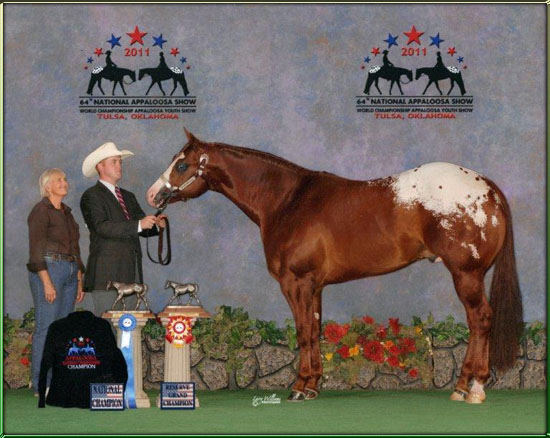
The Secret Pardon


                                                     The Secret Pardon

2008 ApHC Stallion
HYPP N/N

Sire: The Secret - APHC Multiple World and National Champion Sire

Dam: Pardon Me Poise - APHC Multiple World and National Champion Producer
2009 APHC NATIONAL CHAMPION YEARLING STALLION

2009 APHC RES. NATIONAL GRAND CHAMPION STALLION

2009 APHC NATIONAL CHAMPION MOST COLORFUL AT HALTER

2008 APHC NATIONAL CHAMPION WEANLING STALLION

2008 APHC RESERVE WORLD CHAMPION WEANLING STALLION
This young sire has a tremendous show record, all the color desired in a stallion prospect and breeding record second to none!
Owned by James & Laurie Rylander of Sweetwater Farms
Brewster, Ma.
2011 Stud Fee - continuing the Economic Stimulus Package of $800
Visa and Master Card accepted. 
Shipped semen available.


Sire:
The Secret 
(APHC)
{
Dreamfinder (APHC)
Kendalite N Roses (APHC)

Dam:Pardon Me Poise(APHC)
{


Saturday, February 12, 2011

Turnout sheets/blankets

Top 5 turnout sheets

When blanketing your horse for those chilly nights leading up to winter months, picking the right turnout sheet that isn’t too heavy but is comfortable for your horse and does the job at hand. Since I live in Ontario, Canada the weather can be unpredictable and this past August we had a massive head wave of 40+ Celcuis (100 F) as soon as September hit the nights got a bit cooler and also we had a week of rain which made it more chilly and muddy. Depending on where u live you may want to have a rain sheet or a waterproof turnout sheet. A turnout sheet is a sheet with no fill or light fill up to 120 grams, you don’t want to put a sheet that is a turnout blanket because on those warmer days where it is 15 C (59 F) your horse will overheat unless you can get out to the barn to remove it or put a light one on.

My top pick is:
1)  no picture available. 
Riders international turn out sheet
This sheet comes in 4 color options, and pony sizes (48”-64”)- 66”87”Horse size , 640 Denier rip stop, poly cotton mesh lining, tail flap, fleece at the withers to prevent rubbing, it also comes with legs straps which are excellent incase your horse roles the sheet will stay in place.
Prices:
Pony (48”-64”) -$119.95-79.90
Horse (80”-87”)-$134.90-84.80
Horse (66”-78”)-$129.95-89.90
Places to buy: Doversaddlery.com


2) 
Amigo Mio turnout sheet (pix above)
This sheet is a 600 Denier polyester shell that is waterproof and breathable, coat smoothing and nylon lining, Also has a Rambo original cut design and front leg arch for freedom of movement? Distinctive two toned color, in 3” increments, sizing : 66”-84” The only thing i suggest with this sheet as the front buckles are not adjustable, is to go down in sizing for your horse so it isn’t too big because it comes in 3” increments rather than the normal 2”.
Price: $64.00-$59.90
Places to buy:
Smartpakequine.com
Netequestrian.com
Doversaddlery.com
Victorycanter.com
Adamshorsesupply.com


3) 
Weatherbeeta Landa turnout sheet (picture above)
600 Denier polyester shell with nylon lining, freedom dart gusset design, taped seams, tail flap, two buckle front closure and removable nylon leg straps. Fully waterproof and breathable, sizing: 69”-87
Prices: $121.95-$99.90
Places to buy:
Smartpakequine.com
Netequestrian.com
Doversaddlery.com
Victorycanter.com
Adamshorsesupply.com


4)
Tuff rider stretch manager turnout sheet (picture above) 

This is the first waterproof/breathable stretch fabric in the world .The tuff rider stretch manager stretches as the shoulders move, providing un paraleeled freedom. Stretch webbing in chest closure for easy grazing and bending. 100% polyester, 3 color options, (70”-84”)

Pricing
$89.90-99.95

Places to buy
Smartpakequine.com
Netequestrian.com
Doversaddlery.com
Victorycanter.com
Adamshorsesupply.com


5)
Curvon baker turnout sheet

-long wearing ,famous baker plaid shell
-1200 denier ripstop nylon shell
-nylon lining
-no fill
-treated to repel dirt and stains.
-waterproof/breathable lining
-bias surcingles, elasticized leg straps
-shoulder gusset, double front closure
-sizes: 66”-84”

Price:
$129.90-$139.95