Showing posts with label horses. Show all posts

Saturday, November 2, 2013

Horse is For Sale

I have decided to put my Appaloosa mare up for sale, it is a tough decision, but I'm no longer riding and am moving on in life. I want her to go to someone that will take care of her and treat her well so she can have a happy and healthy life. Shes been in professional training since march 2013 until now.. so 9 months , she jumps, does her changes, is very well mannered in the saddle and on the ground. Also has amazing bloodlines for breeding, has not been bred ever. Is registered with the ApHC

Pedigree: http://www.allbreedpedigree.com/windy+sea+breeze


DeeDee 


FOR SALE 


Wednesday, September 5, 2012

Who should I breed my mare to??

Breeding my Appaloosa mare has been a dream of mine since I got her when she was 6 months old, she is now 8 and doesn't have a show career.. but is fantastic to ride, has amazing colouring and hall of fame bloodlines on both side. I was planning on breeding her last season but nothing was working out for me so I decided not to. I had the stallion and breeding contracts in my hand ready to sign too but I decided not to. Which Im glad I waited because I love riding her, she is a 2004 15hand appaloosa mare which I ride her English hunter/jumper. A few sires I have in mind are:

My little Secret:
2009
15.3hand bay with white blanket appaloosa stallion, standing at Char O lot ranch.
Stud fee:$1000
Saudi Arabia prince owns him
3X world champion already, his grandsire "The Secret" is also syndicated


Acore:
2005 16.1 hand
Bay canadian warmblood stallion
Jumper/Grand Prix


Westporte:
Westporte is an imported Hanoverian, standing 16.3 hands, dark bay, has competed hunters, jumpers and has produced some fancy hunters and champion offspring.


There are many others to choose from.. I definitely want to breed her to another appaloosa to see what I get, I have a few foals that I want from her also to continue her bloodlines. My search will continue....

-Meaghan S.


Thursday, April 26, 2012

Entry Level Reining.. Have you tried it?


NRHA’s program for beginning reiners provides a fun, educational, and family-oriented ladder of competition.


The program: The National Reining Horse Association’s new “starter levels” of competition, which debuted in 2010, welcome riders of all backgrounds and abilities to the sport of reining. The Green Reiner class in particular takes the pressure off if you’re at the very beginning/introductory level of the sport, and wouldn’t feel comfortable in NRHA’s more competitive Rookie Reiner division. Green Reiners compete at one of two levels depending on prior points and monies earned, so that the more advanced Green Reiners aren’t mixed in with the newest of the newbies. Moreover, once a rider earns 100 Green Reiner points, he or she is no longer eligible to compete in that class, making it truly an entry-level competitive opportunity. NRHA’s complementary “Ride” and “Slide” classes offer small steps up to slightly tougher competition, creating an inviting ladder by which you can improve your performance in the sport.
Players: All types of riders. You need only an NRHA associate membership ($20) to compete in any of the entry-level classes, and you needn’t even own the horse you show. For both the Green Reiner and Ride classes, neither non-pro declarations nor competition licenses are required.
Other Advantages: Patterns are tweaked to make first experiences less intimidating. In Green Reiner classes, for example, you can ride with one or two hands, plus choose between simple (through-the-trot) or flying lead changes. Ride classes may also have reduced pattern requirements. You don’t need fancy gear or attire, either—just a long-sleeved shirt, a hat or helmet, boots, and a Western saddle and bridle.
Good to Try If: You’ve always admired reining but thought it was “above your pay grade.” In these classes, the atmosphere is supportive and encouraging, and you’ll always be competing against riders with about the same level of experience as you.
Success Tip: Work with a trainer or a knowledgeable friend to learn the basics, watch how the pros and experienced non-pros do it to absorb their knowledge and techniques, and ride a veteran reining horse if at all possible. “A seasoned horse allows you to learn how to rein versus trying to school a green horse while you’re learning yourself,” recommends Butch Human of Advance, North Carolina. Butch earned his Green Reiner buckle in less than six months aboard his “old war horse,” Mr Jerry Jac. “My wife and I started riding green horses and we struggled. With this gelding, I could go into the pen and think about what I needed to do, instead of worrying about my horse.”
The Buzz: These entry-level classes provide more than camaraderie and the satisfaction of learning and improving. They also offer the chance to win great prizes. By accumulating Green Reiner points at NRHA competitions, riders can earn trophy jackets (50 Green Reiner points) and Montana Silversmiths trophy belt buckles (100 points).
And for the Wee Ones: Youth riders can participate in the entry-level classes they qualify for, and for the smallest fry, there’s the short stirrup class. It uses NRHA Pattern No. 11, created especially for this class. The pattern calls for slower speeds and eliminates flying lead changes. As in the new entry-level classes for adults, the youngsters needn’t own the mounts they ride, making it easier for those great old reining horses to teach the sport to the next generation.

Via: Equisearch  
http://www.equisearch.com/horses_riding_training/have-you-tried-entry-level-reining/

Sunday, February 26, 2012

Common causes of weight loss in Off track thoroughbreds


Learn about some common causes of weight loss in off-the-track Thoroughbreds (OTTBs) in this excerpt from the book Beyond the Track.

Insufficient calories: If a horse is not receiving enough calories via a combination of roughage and grain, he will lose weight, especially as his "race-fit" muscling disappears. Over the years at New Vocations, I have found that insufficient feed is the number one cause of weight loss in adopted horses.
Parasite infestation: Horses should be dewormed every 60 to 90 days, and at the track, Thoroughbreds are on a schedule to ensure this. While you should request information regarding the horse's last deworming when you buy or adopt him, it may not be available. As a precaution, it is always good to deworm a new horse to help avoid problems with condition as you begin retraining.
Heat: In a hot climate, or during the very warm seasons, a horse that spends long periods in direct sun will burn more calories than a horse that is in a stall, run-in shelter, or in the shade. If your horse is turned out all the time, it is important to provide him a means of shelter and shade. Inside a barn, fans can be positioned to help cool hot horses.
Cold: In regions that experience extreme cold temperatures, or during bouts of cold weather, a horse that is turned out with no shelter to protect him from wind, snow, and rain, will burn extra calories as he tries to stay warm, especially if he's wet. As in areas that experience severe heat, it is necessary to provide adequate cover from the weather. In addition, horses with thinner winter coats or those in the coldest climates may benefit from a blanket or rug.

Fighting insects: Thoroughbreds hateinsects. They tend to be thin-skinned and especially sensitive to biting flies and mosquitoes, so expect the weight to "melt" off your horse if he spends too much time fighting the bugs--inside as well as out. There are a variety of products available, including sprays, wipes, masks, and sheets, that can help keep your horse comfortable. And, scheduling turnout for the least buggy time of day is recommended.
Pacing the fence: Running back and forth along the fence line obviously contributes to weight loss. This can be due to initial anxiety about being turned out, boredom, horses in neighboring paddocks, or a lack of company in one's own. I explain how to avoid or deal with this problem further in Beyond the Track.
Sickness: One indication of illness or disease is weight loss. Illness also weakens the horse's defenses against sudden changes in weather and parasite infestation, which contributes to the problem. If a horse is in poor condition and seems depressed, off his feed, or otherwise unwell, have your veterinarian examine him to rule out an underlying problem.
Teeth: Horses may have difficulty chewing and consequently digesting their food if teeth are sharp or in poor alignment. Watch the horse eat and note if he drops a lot of food out of his mouth while he chews. Other indicators of mouth discomfort can include issues with the bit, head-tossing, or poor behavior. A veterinarian or equine dentist can check your horse's teeth and "float" them--file down sharp and rough edges that may be causing problems.

By Anna Morgan Ford


Hawaii Banner

Wednesday, February 8, 2012

A safe and successful eventing season starts in the barn


Equisearch
By Jim Wofford


You don’t need to be riding to improve your chances of success in the coming season, Jim explains.

January is the time of year when you can take care of things you don’t have time to take care of the rest of the year. Your horse is just coming back into work, or maybe you’re riding less because of bad weather, so your ability to practice shoulder-in or jumping related distances is limited. However, there are several things you can do now that will make the coming season enjoyable and, more importantly, safer for both you and your horse. The details I have in mind are not directly involved with your ability to sit the trot, but you will sit the trot with a great deal more peace of mind if you have taken care of some, or all, of the following suggestions.
Inspect Your Trailer
Your horse is your best friend, especially when he is thundering down to something that is bigger than anything you have ever seen before and it is cemented in the ground. Don’t you think that he deserves a safe and comfortable conveyance when you are hauling him around to lessons and competitions?
Somewhere in that pile of old mail on your desk is the owner’s manual that came with your gooseneck. Find it and open it to the page marked “Maintenance.” Read it. Do it.
Before you take your trailer in for service, look closely at the interior.
Have any sharp metal edges suddenly ­appeared? Are any of the partitions bent or out of alignment? Is there anything else in your horse’s traveling space that might pose a hazard to him? If so, now is the time to take care of it.
If you have had your trailer for several years and you have been at least normally active, it might be time to replace your tires. If you do not use your trailer on a regular basis, yet have been plagued by
a series of flat tires, you may need to ­replace your tires due to dry rot rather than loss of tread. Each of your trailer tires rotates with the help of mysterious creatures called “bearings.” All you need to know about bearings is that they require care on a regular basis from someone who knows far more about machinery than you and I.
What about your brakes? They need regular service, and your maintenance guidelines will tell you what is needed and how to go about it.
While your trailer is in the shop for its annual rehab, make sure that all of its brake lights, backup lights and running lights are operational. You will need this to pass your state inspection, but you want to take care of these details based solely on your desire to have the safest possible environment for your four-legged friend.
If your trailer is of a certain age, lift the floor mats and make sure that the flooring itself is safe. Some older trailers have wood floors, which have a distressing tendency to rot over time, starting at the back end. However, metal floors can also corrode and deteriorate, and they need to be checked.
While your trailer is in for service, make sure that the hitch apparatus is greased, adjusted and maintained. In addition, if you have been towing your trailer with the same ball hitch on your truck for a long time, have your mechanic check that the ball has not shrunk. It’s a long shot, but the ball can become so worn that the trailer hitch pops off—and it’s preventable.
If you take care of everything we have just talked about, it will cost you a little money. But it is a small investment in your peace of mind about your horse’s well-being, and it is a very small down payment on the vet bills you could incur if you don’t take care of maintenance.

Inspect Your Tack
You also need the month of January to conduct a rigorous safety examination of all your riding equipment.
Start with the bit itself. If it is a loose-ring snaffle, is it starting to show signs of wear where the ring goes through the bit? Are there tiny cracks appearing in the metal? Is there a flat worn spot visible in the ring? Any of these can be a sign that your bit is about to break. You will probably train in perfect safety all spring, yet it will come undone on you halfway around the season’s first cross-country course because that’s the way these things work. However, a little attention during the winter months can prevent a dangerous situation from occurring.
Look at the rest of your bridle. Are the cheekpieces worn? Is it time to replace the keepers because they have stretched out so much that they will no longer “keep” the cheekpiece straps? (That’s a pet peeve of mine because a horse whose bridle lacks effective keepers looks like a hedgehog coming at you.)
Then move your inspection to your reins: If the leather part that wraps around the bit is beginning to show a groove, it is time to replace them. Undo the reins from the bit and inspect the ­internal stitching next to the hook stud or buckle that fastens the rein around the bit. The stitching should still be complete, and the hook stud or buckle itself should still be solidly fixed on the inside of the rein. If you have difficulty getting your reins off the bit, that means your tack maintenance program is badly in arrears and now is the time to fix it. Neatsfoot oil is cheaper than a visit to your local tack-repair shop. In my tack room,
I have several of my father’s bridles. Some of the leather is 75 years old, yet it is supple and the leather glows ­because it has received regular attention.
Working back along the reins, if you use rubber reins, be sure that the rubber hand grips have not started to separate or fray. A skillful tack-repair service can replace them, which is cheaper than a new pair of reins. This should only be done once because of the extra stitching involved, which will weaken the reins with repetition.
Inspect all of the leather parts of your reins for cracks and gouges. In case of doubt, get your tack-repair person to give you an opinion. If you’re still in doubt, then it is time to invest in a new piece of equipment, because you would rather be safe than sorry.
If you are not riding much during the winter, have your saddle’s panels restuffed. While you are at it, repair and replace the billet straps as needed and certainly, if your saddle is an older model, make sure that the material to which your billet straps are stitched is sound and in good repair.
Although a stitch in time saves nine, nine stitches in your stirrup leather buckle might mean the difference between a successful season and a long time spent on crutches wishing you could ride. The stitching at the buckle end of the stirrup leather is the tack area that I most commonly find in disrepair at lessons.
Check Your Horse 
While your horse is not in serious exercise, schedule his annual physical checkup, which should be a complete workup. Unless your regular veterinarian is unusually gifted, this annual checkup should involve a trip to the nearest veterinary school or equine diagnostic clinic.
What should a complete workup ­include? More than the obvious. It is a given that an examination will include the horse’s eyes, lung function and heart as well as external blemishes and superficial injuries or old injury sites. However, you should request flexions on all four limbs, and X-rays should be taken following any positive reaction to a flexion test. Chances are that the reaction is something minor, but you will feel better starting your next training period if you know that you have a minor condition that will be improved, rather than worsened, by exercise.
While you are at it, the clinic team should provide you with a written critique of your horse’s feet and his shoeing with suggestions for improvement. (On your return, be sure you go over this carefully with your farrier. If he is ­resistant to expert advice offered in a constructive fashion, then you need a new farrier.)
Your horse’s annual examination should also include a wide spectrum of blood work. This will tell you a great deal about the state of his health, including any mild form of anemia, the effectiveness of your deworming program and the presence of any lingering low-grade systemic infections. These days, you also need tests for any diseases such as EPM or Lyme that are prevalent in your area. As part of these blood tests, remember to obtain a new Coggins test. Ask the clinic staff to keep you apprised of any new transport requirements—for instance, whether your state now requires a six-month current Coggins, rather than one year. And so on.
If you are competing in FEI events, be sure to bring your horse’s passport to the clinic and make sure it is up to date in every aspect—especially regarding the required flu shots. Also remember that old wounds can heal with white hair rather than hair of his overall coat color. The passport must be changed to reflect this in order to ­remain current.
While your horse is at the clinic, be sure to bring a label from his feed bag and get advice about his nutrition.
Update Your Info
What are some other things you can do during the winter that will make your warm-weather experience more enjoyable? Go online and make sure that US Equestrian Federation and all the other affiliate organizations to which you ­belong have correct information in their user-profile database for both you and your horse. One reason to be sure now that the ­information in the database is correct is that more and more competitions are accepting online entries. If your information is out of date or ­incorrect, you run the risk of the competition’s computer rejecting your entry. Check to make sure everything is correct now to avoid being placed on the waiting list rather than having your ­entry accepted.
Make several copies of all of your membership numbers and of your horse’s registration numbers and competitive records and stash them in various places: your brief case, your vehicle’s glove box, your tack trunk … so you can access them should a competition not be able to find the required information.
If you have not yet joined the various organizations for the coming year, make sure to do it now.
Continue Your Education
Finally, in case you haven’t looked outside yet, it’s still winter. It gets dark early and there’s not much going on. So—read a book. As a matter of fact, I want you to read three books over the next three months. Read one on dressage, one about stadium jumping and one of your choice. Obviously I think my own books have something to offer to you, and you can read my extended reading list here. ­However, a good place for you to start would be with Wilhelm Müseler’s Riding Logic for your dressage book. (Herr Müseler includes some advice about show-jumping in the back of Riding ­Logic—­ignore it.) If you have not read Bertalan de Némethy’s classic Show Jumping: The de Némethy Method, then do so.
For your third book, I prefer you choose one that discusses technique and training rather than one that is ­autobiographical in nature. There are many autobiographical books out there based on the writers’ horse exploits, and they are fascinating and fun to read, but they usually do not increase your knowledge of how to ride and train the way books specifically written for that purpose do.
Anyone with a full-time job will tell you that continuing professional education is a necessity in the modern business world. To continue to improve and succeed in the horse world, you must take the same diligent, disciplined attitude toward continuing education about riding and training as you do toward your professional career.
If you take care of all of these details, I am sure your horse will take better care of you and you will have a safe and enjoyable season.

Sunday, December 4, 2011

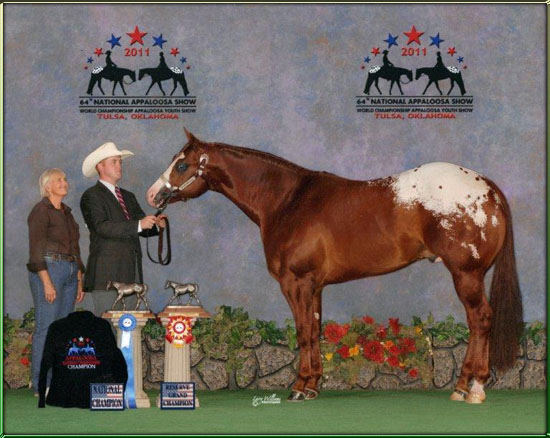
My Little Secret "Doug"

My Little Secret 
2009 Appaloosa Stallion
                                          Sire: Secret Kid- APHC Multiple World and National Champion 
SireDam:  My Prety Centerfold- APHC


My Little Secret Syndicate is proud to announce their new ownership, H.H.
Prince Waleed Khalifa Al Saud of Jeddah, Saudi Arabia The Prince plans to have frozen semen shipped from the US to Jeddah to breed to his band of Arabian mares.

My Little Secret "Doug"
Will remain in the US at Char-O-Lot Ranch and his book will be open to a limited number of mares for the 2012 season at $1,000.00 per mare.


Groupon:$17 for $70 at Vista Print

Monday, June 6, 2011

EHV-1 Virus outbreak


The horse community is on high alert due to an outbreak of a contagious and potentially deadly equine virus that has prompted regulatory and industry organizations to institute quarantines and travel restrictions in Arizona and other western states.
The Arizona Department of Agriculture confirmed the first case of Equine Herpes Virus (EHV-1) in an Arizona horse on May 17. The horse was exhibiting symptoms of severe neurological disease, adding to the numerous recent reports of EHV-1 among horse owners across the U.S. and Canada.
“In an outbreak of EHV-1 neurologic such as we are experiencing now, the disease can reach high morbidity and case fatality rates,” said William Moyer, president of the American Association of Equine Practitioners.
To date, one horse fatality and three confirmed cases of EHV-1 have been reported in Arizona.
EHV-1 is a highly contagious airborne virus that spreads quickly among horses, but is not dangerous to humans.
According to the United States Department of Agriculture (USDA), the current outbreak can be traced to horses attending the National Cutting Horse Association (NCHA) Western National Championship event held April 29-May 8 in Ogden, Utah.
A report issued by USDA on May 19 indicated 21 Arizona horses were exposed at the Ogden event, with 67 Arizona horses secondarily exposed.
Dr. John Hunt, Arizona’s state veterinarian, said that all of the horses and premises in Arizona known to have been exposed through the Ogden event are under close observation, and as of press time, no new cases of neurological disease have been observed.
The incubation period after exposure to EHV-1 is one to two days, with fever then setting in. Neurologic symptoms typically manifest eight to 12 days after exposure.
Early symptoms of the virus can mimic many other illnesses, explained Dr. Abbie Reidhead, owner of Holbrook Veterinary Clinic. It’s when horses begin to exhibit neurologic symptoms, indicating that the horse has the more serious neurological form of the virus, that horses may begin a rapid decline.
Reidhead encourages horse owners to promptly seek medical advice if their animals show symptoms such as runny nose, lack of appetite and fever.
More serious symptoms include poor coordination, hind end weakness, lethargy and urine dribbling.
There is not a vaccine or a specific treatment for EHV-1, although antiviral drugs may be of some help prior to neurological symptoms setting in. Anti-inflammatory drugs are also widely recommended.
“Memorial Day weekend is one of the biggest horse event weekends of the year and kind of kicks off the rodeo season, but we’re encouraging people not to take their horses anywhere,” said Reidhead.
Her advice is echoed by regulatory and industry organizations across the country, with Hunt emphasizing that it’s at events where horses are brought together from different places that the virus is more likely to spread. In response to the outbreak, several horse-related events in Arizona have been cancelled and some horse parks have temporarily closed.
Locally, the Navajo County Fairgrounds is responding to biosecurity guidelines that call for a 21-day quarantine of all horses in boarding facilities, directing facility managers to not let boarded horses leave the premises until the quarantine, which is currently in effect until June 10, is lifted.
“We can’t let the horses that are already here leave the area, and we can’t receive overnight travelers unless owners have written clearance from a vet, dated no more than two days prior, that says their horses do not have the virus,” said Leia Barbea-Haro, secretary at the Navajo County Fairgrounds.
Reidhead said that the situation needs more monitoring before it can be said for sure when quarantines will be lifted and the danger declared over.
“The Department of Agriculture needs more time to determine where all the confirmed cases are and how the outbreak is spreading before it can say when the health alert will be lifted,” she noted.
Reidhead explained that owners aren’t likely to find the virus among their horses if they haven’t traveled recently or allowed other horses to visit their premises.
As of press time, she had not seen any cases among her patients, nor had she heard of any cases in the area.
“Keeping your horses home is the best bet until the outbreak passes,” Reidhead concluded. “It’s not worth losing your horse over one rodeo. ”
Updates on the status of the virus are posted weekly at http://www.aphis.usda.gov/vs/nahss/equine/ehv/.


Thursday, June 2, 2011

Indelible image appaloosa stallion

Indelible image appaloosa stallion, By "The Secret"


With every breeding share:
 $1,000 will be deposited to the Promotion, Incentive, and Futurity account. It will be fully funded at $20,000. That money will be available for the syndicate members to decide how much and where we spend it. We have it before we spend it! There are no unknown surprises in the mail for added expenses. There will be an Indelible Image Futurity each year. It will be held during the World Show (similar to NSBA). Every Indelible Image foal or get in the designated classes are entered automatically. We pay back to 3 places. The first year will be current year foals. The second year will be current year, yearling halter foals and yearling longe line and Hunter In Hand. The third year; the members decide. We anticipate the payback will be $1,000 to 1st, $750 to 2nd, $500 to 3rd. You do not have to win the World Show class, but be placed in the top ten.

$1,000 will be paid back to the horse by Indelible Image with the highest number of open points at the end of the year. A minimum of 10 points will be needed to qualify. Every horse by Indelible Image will receive $100 for the first open halter point earned every year the first 5 years of the syndicate. At that time it will be decided by the shareholders. All advertising and training fees will be taken from the promotion account owned by the syndicate. Each share will be fully insured. All benefits are transferable with the sale of your Indelible Image foal.   


We want people looking for Indelible Image foals first.
Our goal is to breed good mares and reward the owners for the hard work. We are competing with ourselves and the promoting our own breeding program. If each share holder earned one point on their foals, we would move Indelible Image to the top of the leading breeders list which would be one more star on the resume for your foal. We have a very limited number of mares. The way we plan to expand the broodmare band is to offer breeding shares to a few good mare owners that share our philosophy, and want to own a part of the stallion they are promoting. We want to share the success along the way. We would love to see a crowd in the win picture!  He was test bred in 2009. He settled a mare on the first cooled semen shipment. His first foal will arrive in January 2010.  Watch the website. Let us know what you think! We think he is pretty special.


Breeding shares available for the 2011 Breeding season!
Two breedings will be available to the share 
holder the for the “life of the horse”. Of course, there are all those legal things in the “what if” category. The first year we will offer each share for $5,000. The cost of owning will be based on 20 shares. It will be minimal. Projected at $50 a month or less. That includes, vet, farrier, insurance, and promotion. All monthly fees will be deposited to the promotional account that will include training, etc. You can’t even feed a horse for that. 

The Indeliblie Image Syndicate is going to be a little more than your average syndicate. We will be a “marketing group”. We are looking for a few good breeders that share our philosophy. We have a couple of great mares that are consistent producers. We want you to own a part of the bragging rights, right up to the stallion’s name. 


Website:

Pedigree:


Shares available 


Wednesday, May 4, 2011

Legaczy Oldenburg stallion

Legaczy              
  2006 Oldenburg stallion, 17.1h
  By Alla'Czar (Dutch)
    out of All of The Above
        by Buntspecht de Lauzelle


  Provisionally licensed with BWP 

  IHF Nominated  

  2011 Stud fee - $1,000 to select mares


Legaczy is by the renowned Dutch sire Alla'Czar - USEF hunter breeding sire of the year for an unprecedented fiveconsecutive years.  Alla'Czar was a 16.3h imported bay sabino stallion who competed in dressage through Prix St. George, as well as having a successful hunter career in the 1st and 2nd year Greens and the big Equitation rings.  Alla'Czar was by Zeus one of the most sought after show jumping sires of all time.


Legaczy is out of the Oldenburg GOV mare All of the Above, a lovely 17.1h bay who had a career in the rated hunters.  She is by Buntspecht de Lauzelle, who was a Puissance/Grand Prix show jumper and also a Regular Working Hunter Champion.  He was the leading sire in Belgium in 1982 and 1983.


Legaczy is extremely correct, has a phenomenal temperament and jaw dropping movement.

Pedigree


Breeding Contract


Highlights:

  2008:

  *USEF Zone Three 2yo Hunter Breeding Champion
  *MHSA Non-TB 2yo Hunter Breeding Champion
  *VHSA 2yo Hunter Breeding Champion

  2009:

  
*2nd at Devon in the highly competitive 3yo non-TB Stallions & Geldings
  *Provisionally licensed for breeding with BWP
  *Earned good ribbons at the International Hunter Futurity in the 3yo performance division

  2010:

   Legaczy is cross training in the hunter ring with Ken Krome and the dressage ring with Christine Betz.  
 
   2010 Hunter highlights include:    

  *Excellent ribbons at Upperville in the very competitive 3 & 4yo Hunters
  *Ribbons at the International Hunter Futurity 4yo performance division
  *A win at the Warrenton Horse Show in a large unrestricted over fences class

   2010 Dressage highlights include:

  *
ESDCTA Memorial Weekend Dressage - Open 1st Level - 67.667%
  *VADA/NOVA Summer Dressage - Open 1st Level - 66.667%
  *Completion of the BWP 1st level stallion performance requirements  


The Secret Pardon


                                                     The Secret Pardon

2008 ApHC Stallion
HYPP N/N

Sire: The Secret - APHC Multiple World and National Champion Sire

Dam: Pardon Me Poise - APHC Multiple World and National Champion Producer
2009 APHC NATIONAL CHAMPION YEARLING STALLION

2009 APHC RES. NATIONAL GRAND CHAMPION STALLION

2009 APHC NATIONAL CHAMPION MOST COLORFUL AT HALTER

2008 APHC NATIONAL CHAMPION WEANLING STALLION

2008 APHC RESERVE WORLD CHAMPION WEANLING STALLION
This young sire has a tremendous show record, all the color desired in a stallion prospect and breeding record second to none!
Owned by James & Laurie Rylander of Sweetwater Farms
Brewster, Ma.
2011 Stud Fee - continuing the Economic Stimulus Package of $800
Visa and Master Card accepted. 
Shipped semen available.


Sire:
The Secret 
(APHC)
{
Dreamfinder (APHC)
Kendalite N Roses (APHC)

Dam:Pardon Me Poise(APHC)
{


Saturday, February 12, 2011

Turnout sheets/blankets

Top 5 turnout sheets

When blanketing your horse for those chilly nights leading up to winter months, picking the right turnout sheet that isn’t too heavy but is comfortable for your horse and does the job at hand. Since I live in Ontario, Canada the weather can be unpredictable and this past August we had a massive head wave of 40+ Celcuis (100 F) as soon as September hit the nights got a bit cooler and also we had a week of rain which made it more chilly and muddy. Depending on where u live you may want to have a rain sheet or a waterproof turnout sheet. A turnout sheet is a sheet with no fill or light fill up to 120 grams, you don’t want to put a sheet that is a turnout blanket because on those warmer days where it is 15 C (59 F) your horse will overheat unless you can get out to the barn to remove it or put a light one on.

My top pick is:
1)  no picture available. 
Riders international turn out sheet
This sheet comes in 4 color options, and pony sizes (48”-64”)- 66”87”Horse size , 640 Denier rip stop, poly cotton mesh lining, tail flap, fleece at the withers to prevent rubbing, it also comes with legs straps which are excellent incase your horse roles the sheet will stay in place.
Prices:
Pony (48”-64”) -$119.95-79.90
Horse (80”-87”)-$134.90-84.80
Horse (66”-78”)-$129.95-89.90
Places to buy: Doversaddlery.com


2) 
Amigo Mio turnout sheet (pix above)
This sheet is a 600 Denier polyester shell that is waterproof and breathable, coat smoothing and nylon lining, Also has a Rambo original cut design and front leg arch for freedom of movement? Distinctive two toned color, in 3” increments, sizing : 66”-84” The only thing i suggest with this sheet as the front buckles are not adjustable, is to go down in sizing for your horse so it isn’t too big because it comes in 3” increments rather than the normal 2”.
Price: $64.00-$59.90
Places to buy:
Smartpakequine.com
Netequestrian.com
Doversaddlery.com
Victorycanter.com
Adamshorsesupply.com


3) 
Weatherbeeta Landa turnout sheet (picture above)
600 Denier polyester shell with nylon lining, freedom dart gusset design, taped seams, tail flap, two buckle front closure and removable nylon leg straps. Fully waterproof and breathable, sizing: 69”-87
Prices: $121.95-$99.90
Places to buy:
Smartpakequine.com
Netequestrian.com
Doversaddlery.com
Victorycanter.com
Adamshorsesupply.com


4)
Tuff rider stretch manager turnout sheet (picture above) 

This is the first waterproof/breathable stretch fabric in the world .The tuff rider stretch manager stretches as the shoulders move, providing un paraleeled freedom. Stretch webbing in chest closure for easy grazing and bending. 100% polyester, 3 color options, (70”-84”)

Pricing
$89.90-99.95

Places to buy
Smartpakequine.com
Netequestrian.com
Doversaddlery.com
Victorycanter.com
Adamshorsesupply.com


5)
Curvon baker turnout sheet

-long wearing ,famous baker plaid shell
-1200 denier ripstop nylon shell
-nylon lining
-no fill
-treated to repel dirt and stains.
-waterproof/breathable lining
-bias surcingles, elasticized leg straps
-shoulder gusset, double front closure
-sizes: 66”-84”

Price:
$129.90-$139.95